Simpler scoring that younger players and their parents can follow
A ten-skill rubric written for under 10s, every skill judged against what's expected for the age group, and reports families read in words, not numbers. Each team chooses.
A rubric written for under 10s
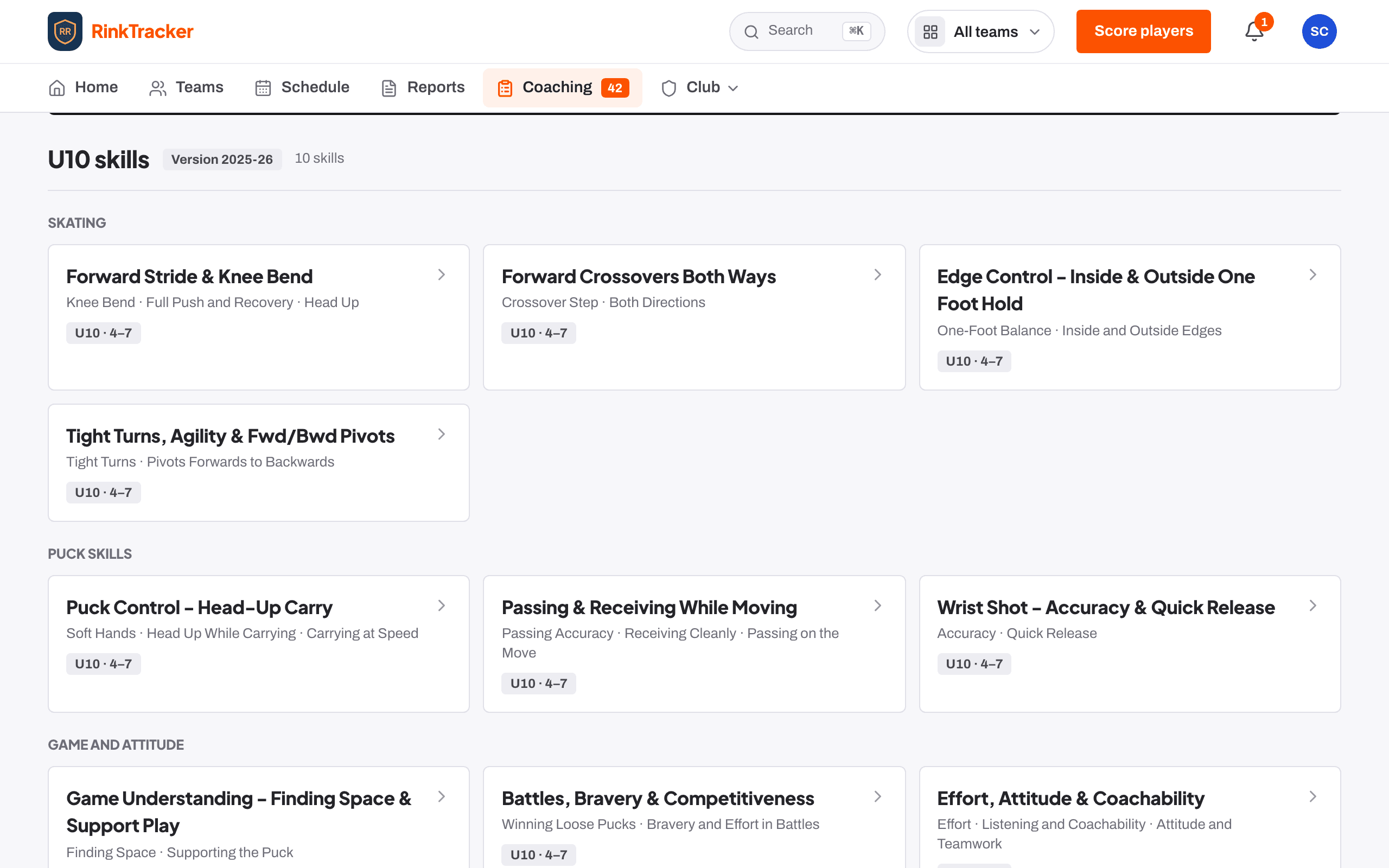
Under 10s have their own rubric: ten skills in three groups, Skating, Puck skills and Game and attitude. Each skill has ten levels, each a short sentence that a young player and their parent can follow, such as "Bends the knees when a coach reminds them, then often stands up again". At this age, 4 to 7 is typical in every skill.
Fewer, clearer skills
Ten skills in place of nineteen, named for what a coach watches, such as Forward Stride & Knee Bend.
The same scale for coaches
Coaches still score from 1 to 10, so nothing changes at the boards.
Judged against the age group
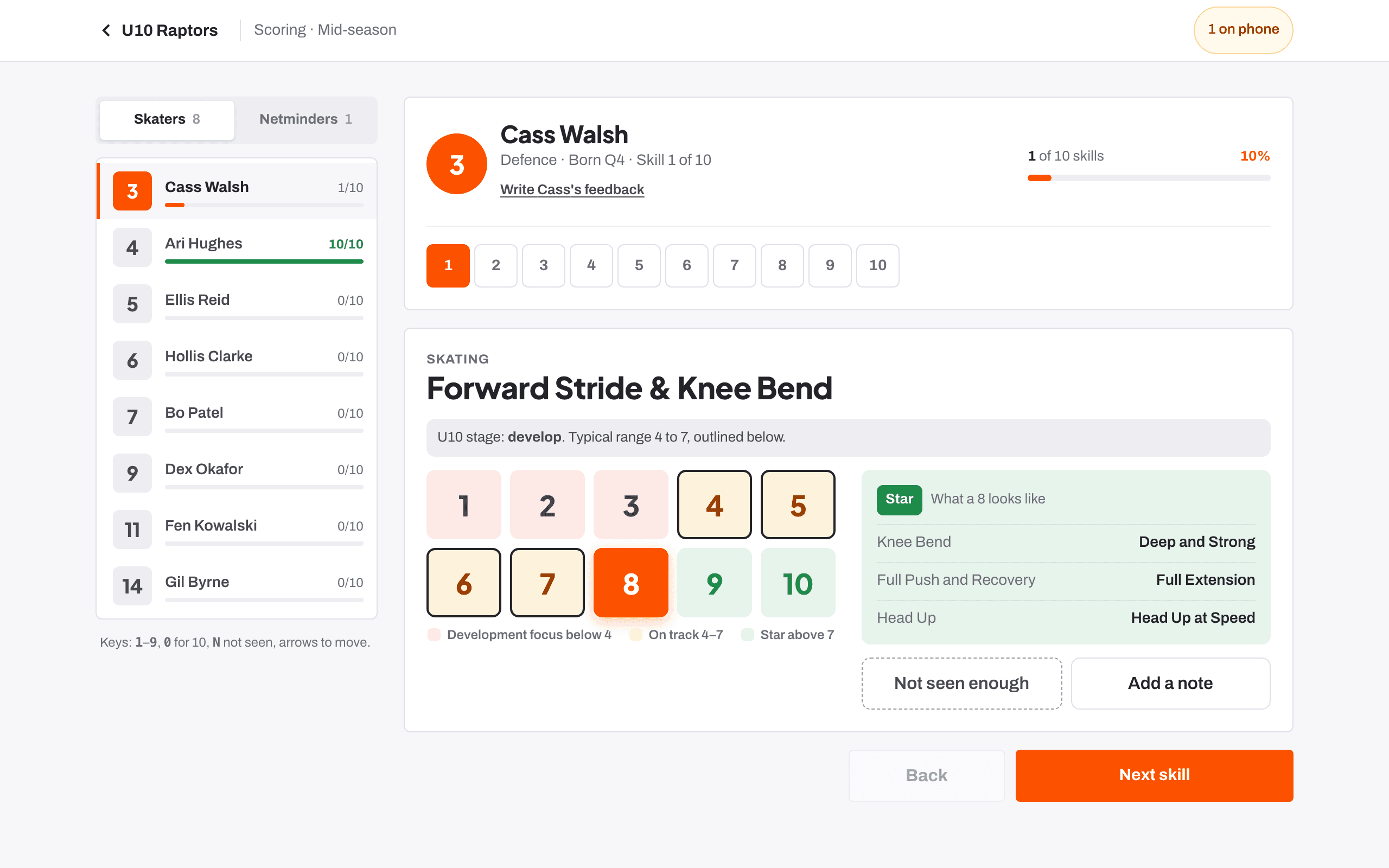
With Star, On track, Development focus, each score is compared with the range expected for the team's age group in that skill. Below the range is Development focus, inside it is On track and above it is Star. For under 10s, 4 to 7 is On track in every skill. On the standard rubric each skill has its own range for each age group, so a 5 in forward skating is On track for an under 12 and a Development focus for an under 14.
Coaches keep the colours
The scoring screen colours each button by band for the age group, with a key underneath.
The range is outlined
The typical range for the age group is outlined on the buttons, so you can see where On track starts and ends.
Older teams too
Under 12s and under 14s can keep the standard rubric's 19 skills and use the same terms, judged against their own ranges.
Words, not numbers, for families
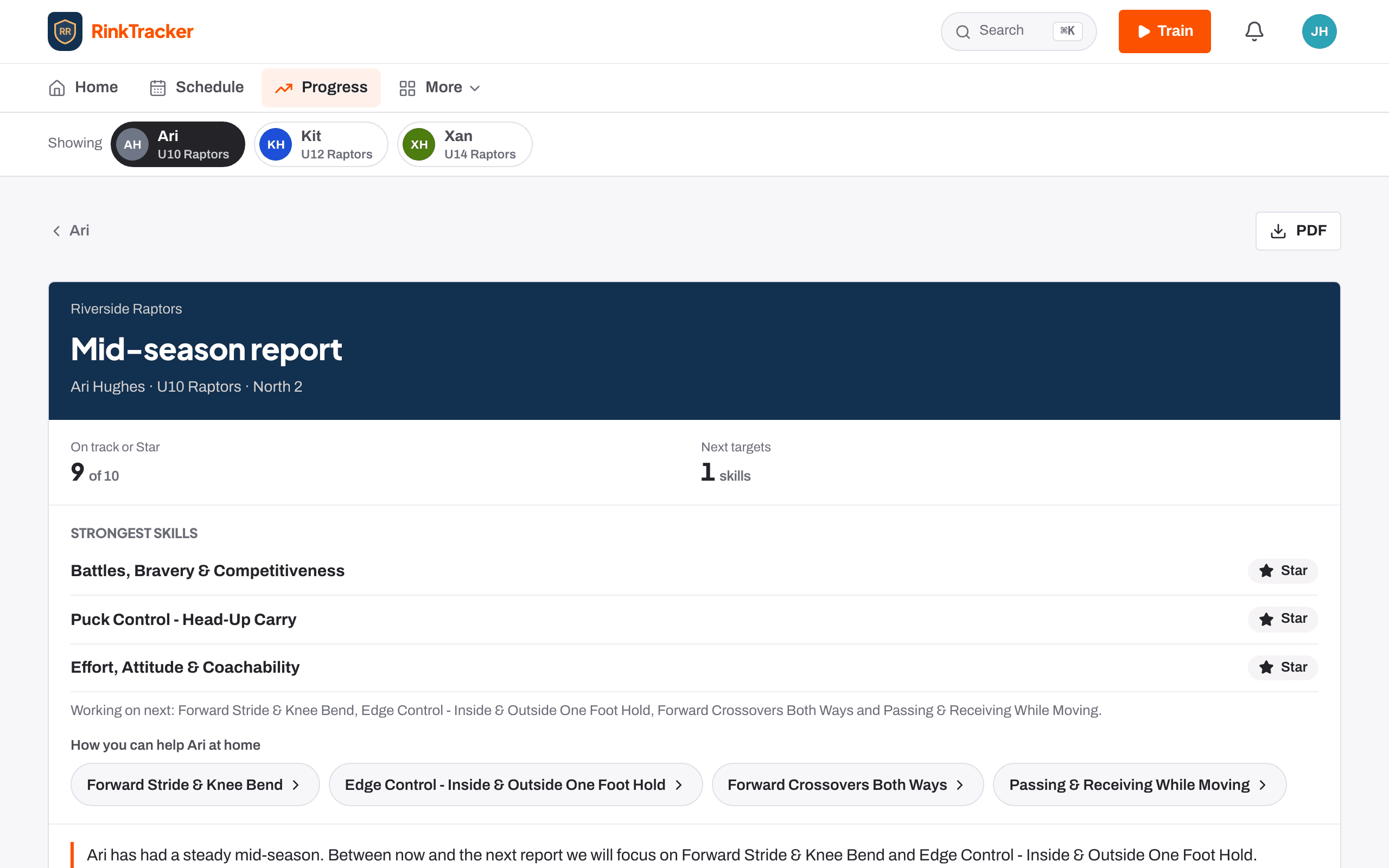
Families see each skill as Star, On track or Development focus, with an icon, in one neutral colour: no 1 to 10 scores, no averages and no red, amber or green. The report shows how many skills are On track or Star, the strongest skills, what the player is working on next and the coach's comment. Goals are written as the next step, never as a number to reach.
A skill profile without a scale
Each skill is a dot against the shaded range expected for the player's age.
Coaches still see the numbers
Scoring, feedback and the coaches' own pages keep the 1 to 10 scores.
A parent toolkit for every skill
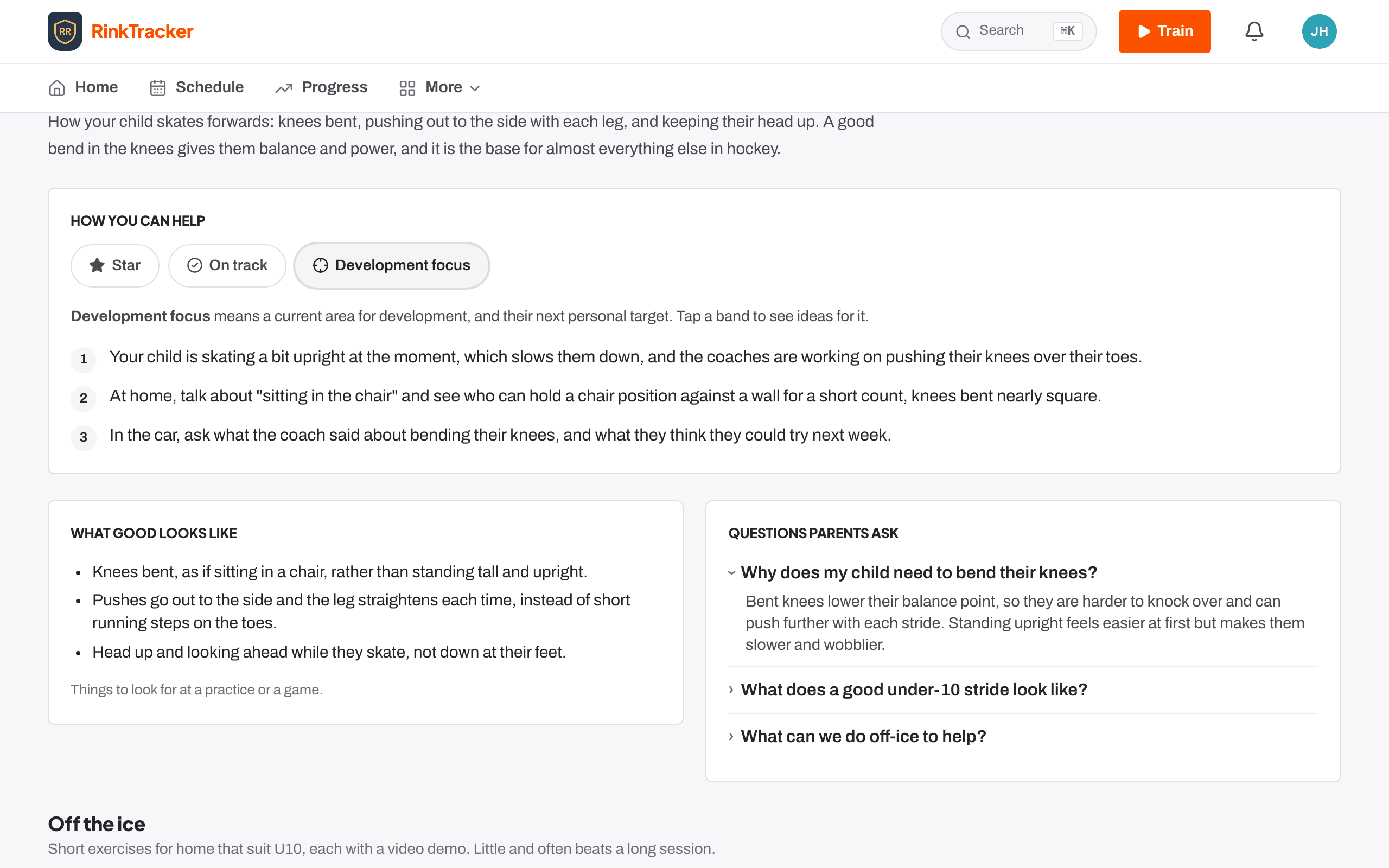
Each skill on the report links to the parent toolkit: ideas for the band the child is in, what good looks like, the questions parents ask and short off-ice exercises for their age. It's written to start a conversation in the car home, not to judge. Head coaches can change any of the wording for their club and add two YouTube videos to each skill: one showing what good looks like, and one fixing the most common mistake.
Your club's videos
Paste a YouTube link from the video's Share button for each skill.
Back to the standard any time
Go back to the standard toolkit removes the club's changes.
Each team chooses
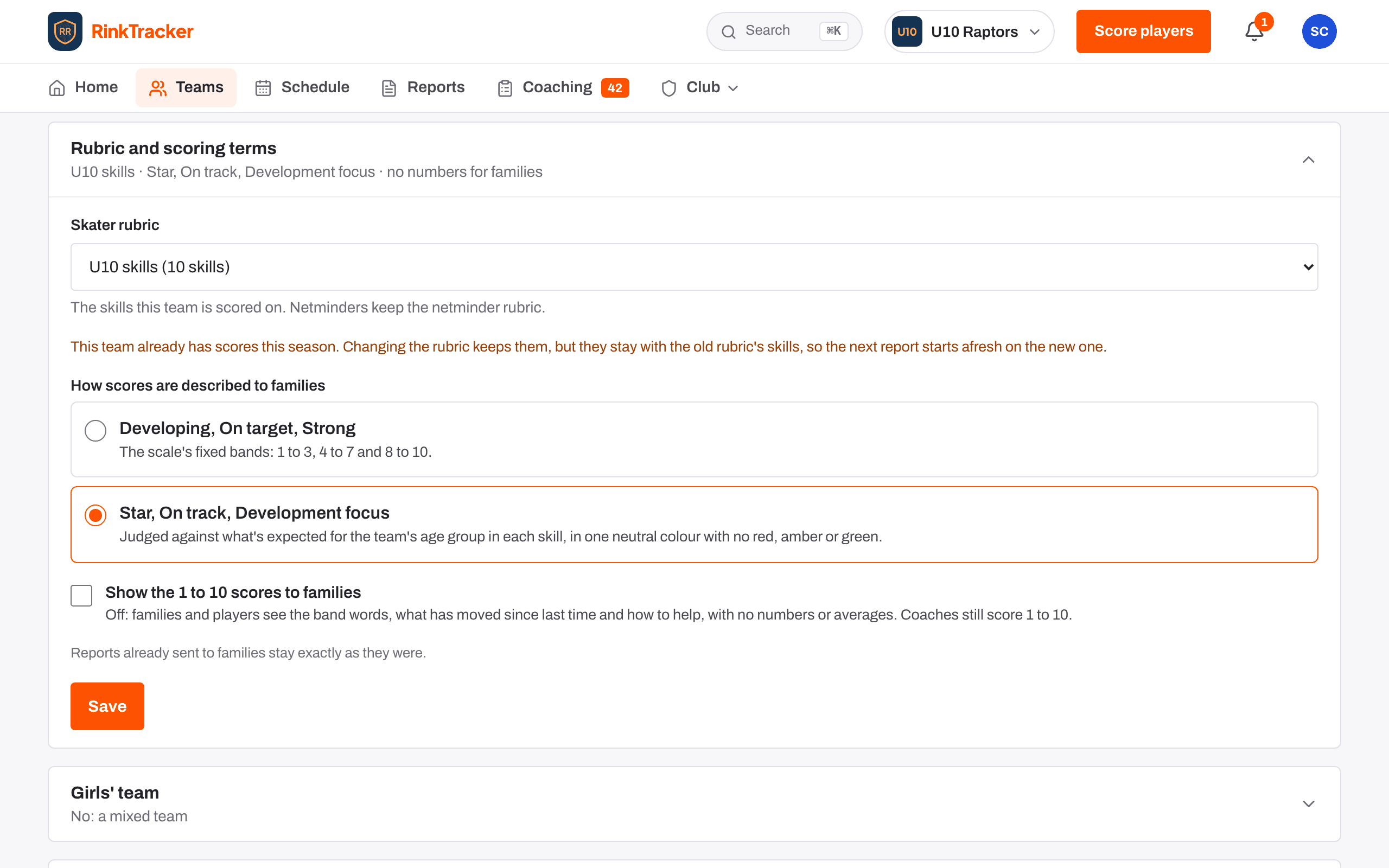
A head coach or club admin switches a team in Team settings › Rubric and scoring terms: choose the rubric, choose Star, On track, Development focus and leave Show the 1 to 10 scores to families off. Under 10s move to the U10 rubric; older teams keep the standard rubric and change only the terms. Every other team carries on as before.
Switch back any time
Scores are never changed, and reports already sent stay exactly as they were.
Best between skills checks
Scores already given stay with the old rubric's skills, so change the rubric between skills checks.